
My Home COO, a home operations consultancy in the Austin, Texas area, published a piece this month on running the holiday season like an operation. It’s a separate business from Nacho, and one we admire. They help high-performing women build the household systems their lives have outgrown, often during a move, a career change, kids leaving for college or a family reshuffle. So when they write about holiday load, they’re writing from inside a lot of very full homes.
One phrase from the piece has stuck with us. They call the holidays “a predictable capacity event.”[1]
For a household, that’s exactly right. Their argument is that the season piles extra work on top of normal life, and the extra work falls on whoever already knows the most about how everything runs. Their answer is to plan for December the way a retailer does, and to give people ownership of whole areas instead of handing out scattered chores. If you’re the person holding your household together this season, read it. It’s the clearest thinking on holiday load we’ve seen this year.
For a business owner, the same event runs in reverse.
What happens when the person everything runs through logs off
Somewhere between December 22 and January 2, most owners of a $1M to $10M business try to step away. Clients slow down, the team takes PTO, and you promised your family you’d actually be present this year.
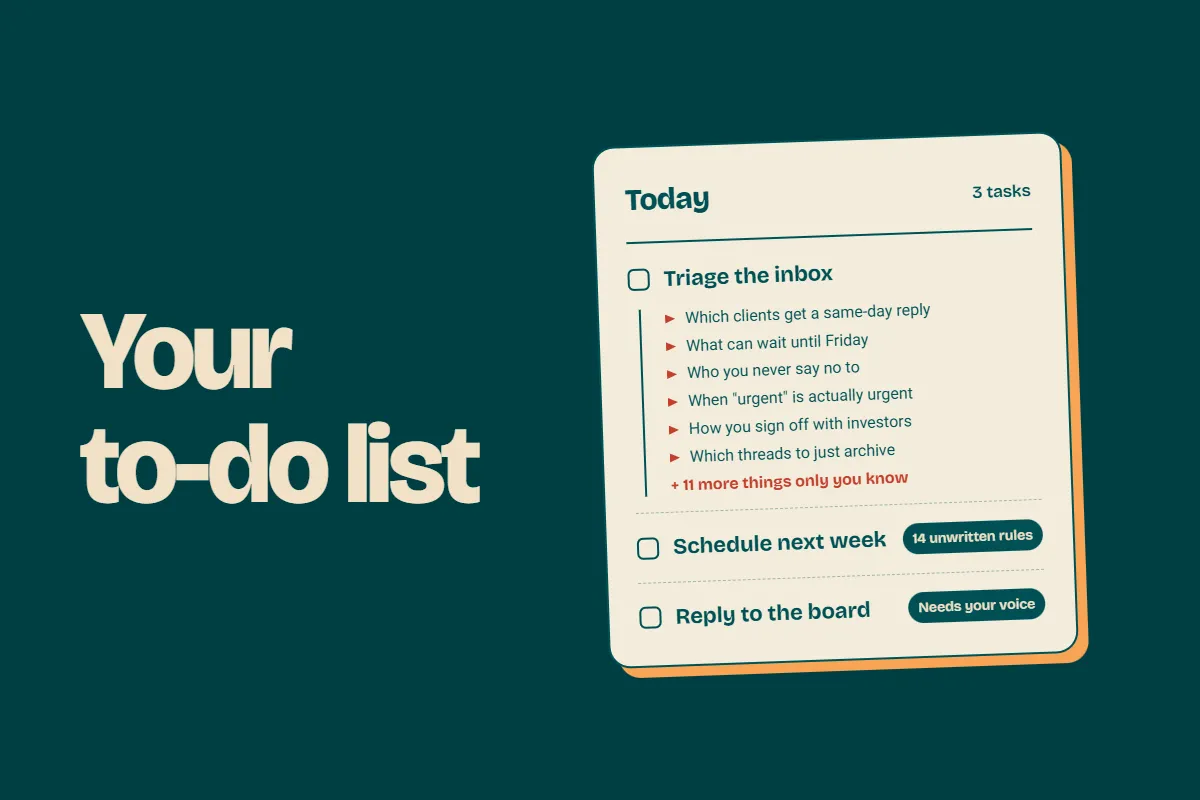
The work doesn’t stop as neatly. A client emails on the 27th with a question only you can answer. A vendor renewal you’ve handled from memory for four years comes due on the 31st. The login for the payroll system lives in your head, and nowhere else.
My Home COO’s point about who carries the load applies here almost word for word. In a household, it lands on the person with the most operational knowledge. In most businesses this size, that person is the owner. So when you log off, a surprising amount of the company logs off with you.
The cheapest stress test you’ll get all year
Most owners never find out what their business does without them, because they never leave long enough to see. The holidays hand you that answer for free.
Before you go, run the two-week disappearance test. Walk through everything that crosses your desk in a normal week and sort each item into one of two piles: slows down while I’m gone, or stops.
Slowing down is fine. Clients expect a quieter December, and most things can wait a week. Stopping is the real problem: a payment that doesn’t go out, an approval nobody else is allowed to give, a client question nobody else can answer.
Whatever lands in the “stops” pile is your actual delegation list. Your inbox and calendar probably aren’t on it. The things on it are the ones only you currently know how to do.
Hand off ownership, not chores
This is where My Home COO’s framework translates cleanly to a business. They make the case for giving one person accountability for an entire area, along with the authority to move it forward, so the organizer isn’t fielding every small question. A company needs the same thing.
“Can you keep an eye on my inbox while I’m away?” gets you a tidy list of emails waiting for you on January 2. “You own client communication through the break, here’s what you can decide on your own, and here’s when to call me” gets you a business that kept running.
Ownership only works with context and decision rules. Context is everything in your head, written down well enough for someone else to act on it. Decision rules are the limits you set ahead of time: approve refunds up to $500, reschedule any meeting that isn’t tied to a client deliverable, call me only if a client is about to walk. Set those before you leave, and the routine questions stop finding their way back to you.
If there’s nobody to hand it to
This is where a lot of owners get stuck. The test shows them exactly what stops, and there’s no one on the team with the context or the authority to take it.
That gap is a staffing problem, and no amount of rescheduling around it will close it.
An Executive Assistant can take ownership of the operational side: client communication, scheduling, vendor follow-up, and the inbox that would otherwise become a January landslide. A fractional COO can own the systems and decision rules, so the business stops routing everything through you, over the holidays and long after them.
Nacho matches owners with talent in about 15 days. If you start the conversation this week, there’s still time to get matched before the break.
Book a discovery callUse the break to write your January list
If you’re not handing anything off this year, run the test anyway. While you’re away, keep a running note of everything that waited for you, broke, or pulled you back in.
By January 2, that note will be the most honest job description you’ve ever written. Do what only you can do. Hand us the rest.
[1] My Home COO, “The Holiday Operating Model,” November 2026. https://www.myhomecoo.com/post/holiday-operating-model