
It rarely happens cleanly. One founder we spoke with recently has a director of six years who is heading back to school. She gave months of notice, which felt generous at the time, and she’s still there. She’s just there for 15 hours a week instead of 50. The founder described what happened next in one sentence: she’s now doing two people’s jobs.
Another owner has had an operations person on leave since May, with no confirmed return date. A third is promoting her longtime assistant into a growth role and wants a clean line drawn so the admin work doesn’t quietly follow her into it.
Three very different situations, and the same gap opens in all of them. The work that person absorbed has to go somewhere, and in the first few weeks it usually goes to whoever notices it first. That’s almost always the owner.
The rehire reflex
The instinct is to post the role and replace them. That instinct runs into two problems.
The first is that the role you’re replacing probably doesn’t exist on paper anymore. A job written four years ago describes what someone was hired to do. What they actually do now grew around them: the vendor who calls them directly, the report only they know how to pull, the client who trusts them. Hire against the old description and you’ll find the gaps one at a time, usually at the worst moment.
The second is timing. You’re hiring under pressure, often while covering the work yourself, which is the state of mind least suited to making a careful choice. One nonprofit leader told us they’d brought in two people over the past year and neither worked out. That’s expensive twice over, in money and in the months lost.
There’s a third problem that’s easier to miss. If you replace like for like, you rebuild exactly the same arrangement, where one person holds so much that their next life change puts you back here. The founder with the departing director saw this clearly. She hired a business coach to help shift the business model so it depends less on any single employee, because even promoting someone internally would leave her exposed to the same risk.
Sort the work before you replace the person
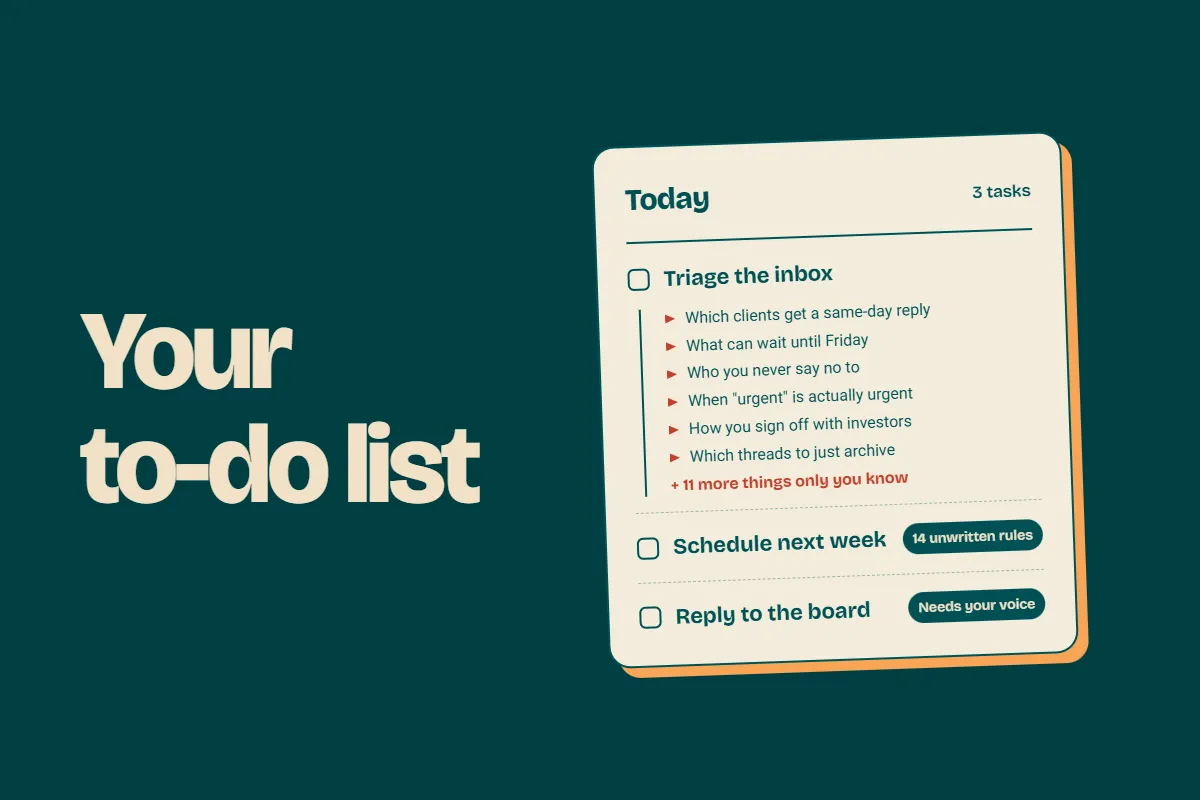
Before deciding what kind of help you need, write down what that person actually does. Not their job description. The real list, including the small recurring things nobody has ever named.
Then split it into two piles.
The first pile is work only they can do, or that took real time to build: relationships they hold, expertise developed inside your business, judgment calls that rest on years of context. The founder with the departing director was blunt about this. There’s no degree in what her team does. The training is internal and experiential, so she can’t simply pull someone else up to fill the role.
The second pile is everything that landed on them because they were there and reliable. Scheduling. Documents. Follow-ups. Invoice processing. Research. The reporting nobody else wants to touch.
The second pile is usually much bigger than people expect, and it’s the pile you can move quickly. It’s also, in our experience, the pile quietly eating the most hours. Deciding what belongs in each pile is worth doing carefully, and our post on reading your own delegation list covers how to tell them apart.
Get help while the person is still there
If you have any overlap at all, use it. One owner whose assistant leaves at the start of next month asked to bring support in early, partly so the new person could ask questions while the old one was still around, and partly because some of the work had already stopped happening.
That second reason is the one people underestimate. The slippage usually starts well before the last day. Notice is given, attention shifts, and the small maintenance tasks are the first to go. By the time you’re formally covering the gap, you’re also clearing a backlog.
Overlap is also your only chance to capture what lives in someone’s head. Ask them to write down how they do the recurring things, who they call when something breaks, and what they’d tell their replacement in the first week. It doesn’t need to be polished. It needs to exist before their last login.
Cover the gap without committing to a shape
Fractional support fits this moment because the moment itself is uncertain.
If someone’s on leave, you may not know whether you need three weeks of cover or six months. The owner in that situation put it well: whether her colleague comes back soon or much later, she knows she’ll need support either way, and she’ll need to give the returning person a soft runway rather than dropping the backlog on their desk in week one.
We’ve been living this one ourselves. Our Client Success Manager, Corie, has been on leave since the spring, and our COO has been covering. It works, and it’s also two jobs for one person, which we knew in month one. Knowing that early is what made it workable.
If someone’s moving into a new role, fractional support lets you draw the line properly. The work that used to be theirs gets a new owner instead of drifting back to them whenever things get busy, which protects the promotion you just gave them.
And if someone’s leaving for good, a few months of experienced support buys you the time to hire the role you actually need rather than the role you just lost. You’ll know a lot more about what that role should be after eight weeks of watching the work get done than you do on the day the resignation lands.
What to do in the first two weeks
Write the real list, including the things that only exist in someone’s routine.
Mark the items that genuinely need that person’s expertise or relationships, and treat everything else as available to hand off now.
Book time with them while they’re still here to capture the how, the who, and the what-breaks.
Decide what “covered” means for the next 90 days rather than the next three years. That’s a much easier decision, and it’s the one actually in front of you.
Losing your right hand feels like an emergency because so much was resting on one person. The useful part of the moment is that it shows you exactly where that weight was sitting, and gives you a reason to spread it out.
If you’re in the middle of one of these transitions, we’d be glad to talk it through.
Book a discovery callAnd if you’re reading this from a calmer week, that’s the better time to work out who you’d call. Nobody schedules a resignation. We post about delegation and hiring on LinkedIn, mostly the parts nobody puts in a brochure. Follow along there, and when your own version of this arrives, we’re one message away.