
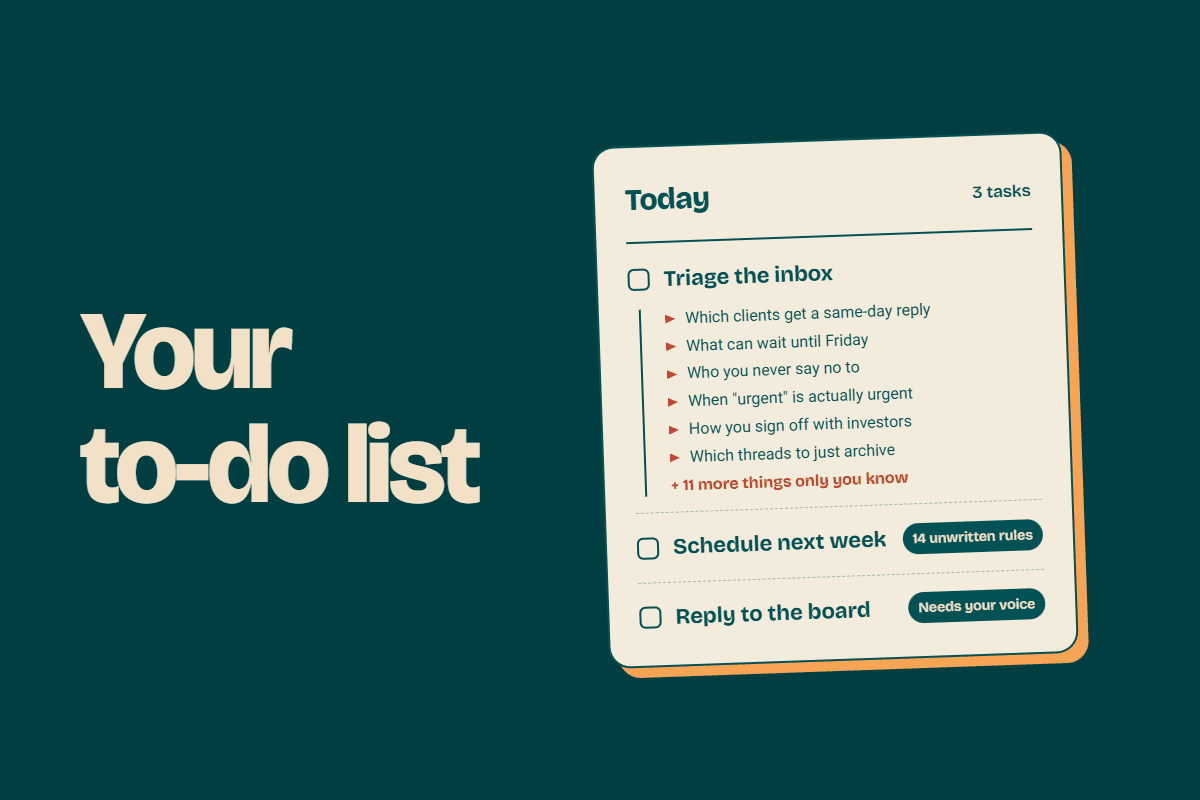
Almost every founder who’s ready for help arrives with some version of the same list. Inbox. Calendar. Filing. Follow-ups. Some research. Maybe a few personal errands they’re slightly embarrassed to mention.
Then they look at it again and have second thoughts. One founder said it to us almost word for word on a recent call: reading back over her list, it looked like something a junior assistant could probably handle. She was right about how it looked. She was wrong about what it would take, and she knew it, because in the next breath she said every item had to be handled as if she were handling it herself.
That gap between how the list reads and what the work actually requires is where most first delegation attempts go sideways.
What the list doesn’t show
Take the inbox. Another founder told us he’d come back from a week of travel to more than a thousand unread emails. About a third of them expected a reply. Somewhere in the pile were two or three that genuinely mattered.
On paper, “manage inbox” is an admin task. In practice, the job is finding those two or three. Someone has to know which client is quietly unhappy, which vendor can wait until next month, which “quick question” is actually a contract issue, and which newsletter he’ll want to read on Sunday. Sorting email is easy. Deciding what matters to this person, in this business, this week, is judgment.
The calendar works the same way. One owner described hers as the Wild West. Meeting requests were booked in the order they arrived, so a vendor who wanted to demo new software could take the slot a new client should have had. Nobody did anything wrong. The person scheduling was following the only rule they’d been given: find an open time.
“Schedule meetings” was on the list. “Know which meetings are worth my time” was never written down, because to the founder it was obvious.
The judgment filter
When we help founders sort their work, we ask one question about every item: what level of judgment does this require?
Execution is usually the smallest part of it. Booking a meeting takes two minutes. Deciding whether it should be booked at all, and what it should bump, is the part that takes experience. Filing a document takes seconds. Filing it where someone will find it at 4pm on a Friday, when they’re looking for it under a different name, takes someone who thinks about how the business actually runs.
Run your list through that filter and something useful happens. The items don’t get harder. They get honest. You start to see which tasks really are mechanical and which ones have a small decision tucked inside that you’ve been making without noticing.
What happens when you hire for the list
If you hire for how the list looks, you’ll find someone whose skills match the tasks as written. They’ll be willing, often quick, and they’ll still need you for every one of those tucked-in decisions.
So you answer the questions. You check the drafts. You rewrite the email that went out a little too casual to your biggest client. You re-sort the inbox they already sorted. The list is technically off your plate, but you’re still doing the hardest part of every item, plus the extra work of managing someone through it.
We hear about this a lot from people who’ve been burned before. One founder told us he gave up on a previous assistant after a couple of months because he’d spent the entire time training someone who should have already known what he was talking about. Another described it as running an internship: teaching someone the job so they could be more valuable to their next client, while paying for the privilege.
Neither of them hired a bad person. They hired for the wrong level of judgment.
What experienced judgment looks like
The founder with the Wild West calendar put what she wanted very simply. She needed someone to protect her from herself.
That’s what an experienced executive assistant brings to a list that looks basic. They hold the line on your priorities, including the day you try to squeeze in “just one quick call” on a morning you’d protected. The priorities themselves still have to come from you, and we’ve written a separate post on handing over the context your EA can’t guess.
In the inbox, they don’t hand you a tidier version of the same thousand emails. You see the three that need you, a short list that needs you soon, and a note that the rest have been handled, with replies drafted in your voice for the routine ones.
For research, they come back with an answer you can act on. If you asked for a list of attorneys, you get rates, availability, a recommendation, and the one question you should ask on the first call.
None of this shows up as a line item on the list. It’s the difference between help that saves you time and help that just moves your time around.
How to read your own list
Before you decide what level of support you need, go back through your list and ask a few questions about each item:
- If this goes wrong, who notices first? A client, a partner, or a donor noticing is a very different risk from you noticing.
- Does it involve choosing between two reasonable options? Most calendar and inbox work does, all day long.
- Would you be uncomfortable if it went out exactly as someone else wrote it? If yes, voice and relationships are part of the job.
- Do you ever do this task differently depending on who it’s for? That variation is judgment you’ve been supplying automatically.
Items that come back “no” on all of these are genuinely mechanical, and they’re great to hand off early. Items with a “yes” still belong off your plate. They just need someone who can make those calls well.
Most of what’s on a typical founder’s list is maintaining work: the steady, recurring tasks that keep the business running. That’s exactly why it should leave your desk. Maintaining work done well still takes good judgment, though, and hiring for that judgment from the start is what makes the handoff stick.
If your list looks simple and you have a sneaking suspicion it isn’t, we’d love to hear about it.